
By Ambrose Kweronda
www.mknewslink.com
In Kabale—-
Minister of State for Energy and Mineral Development (Minerals), Hon. Phiona Nyamutoro, has urged miners in the Kigezi sub-region to organise themselves into cooperatives so that they add value to the minerals if they are to sustain the development of Uganda’s mineral sector.
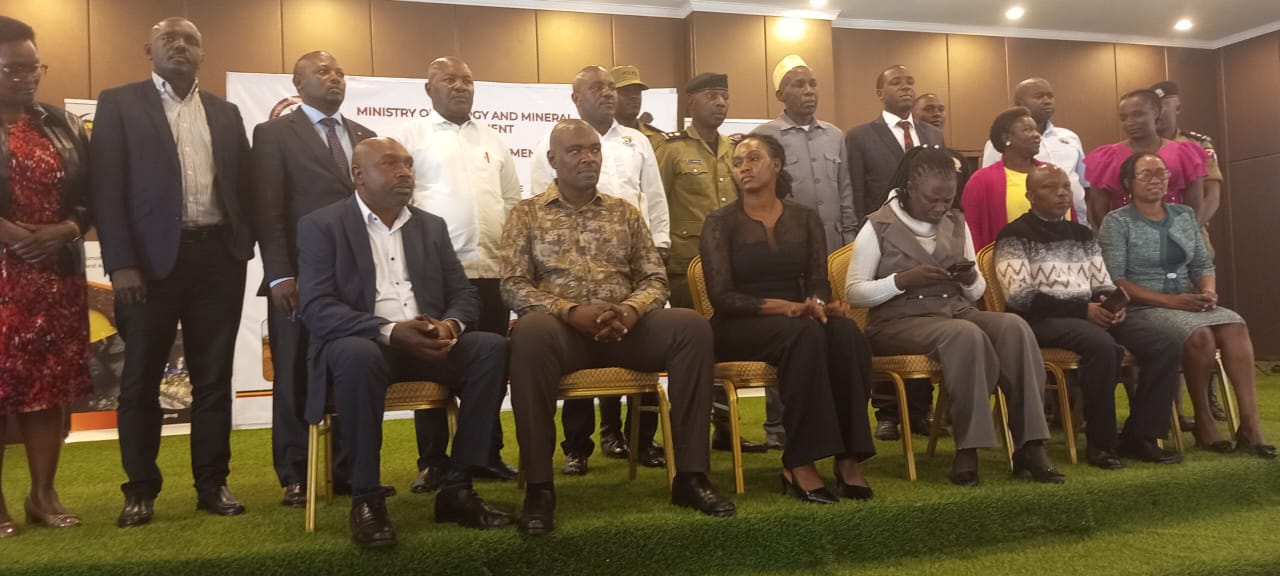
Nyamutoro made the call while addressing miners, Resident District Commissioners (RDCs), security leaders, religious leaders and other stakeholders during a sensitisation workshop held at White Horse Inn Hotel in Kabale Municipality.
The workshop aimed at sensitising district leaders and other stakeholders on the legal framework governing Uganda’s mining and minerals sector, particularly the rights, obligations and compliance requirements of those engaged in mining activities.
She said Uganda had enormous mineral potential that could significantly contribute to economic growth if properly harnessed through industrialisation and local processing.
Nyamutoro commended miners and local leaders for their dedication to developing the country’s mineral wealth, noting that their contribution was vital to Uganda’s economic growth and development aspirations.
She observed that mineral resources in the Kigezi sub-region already supported the livelihoods of thousands of Ugandans, particularly young men and women, but stressed that greater economic benefits could be realised if the country prioritised local processing instead of relying on the extraction and sale of raw materials.
The Minister identified iron ore as one of the minerals offering significant opportunities for industrial development, explaining that processing it into iron and steel products would create employment, stimulate the construction sector and support the establishment of industries that manufacture machinery and other products locally.
She pointed to ongoing investments in Uganda’s steel industry, including projects by companies such as Tembo and Yogi Steel, as well as the proposed Defkey steel plant in Tororo.
According to Nyamutoro, the Defkey project is estimated at approximately US$499 million and currently employs about 900 workers. Upon its projected completion in September 2027, the plant is expected to employ approximately 10,000 people, consume 3,000 tonnes of iron ore daily and produce about 800,000 tonnes of steel products annually.
On government support for local miners, Nyamutoro said the Ministry had granted medium-scale mining licences to the Chigezi Iron Ore Miners Association and an exploration licence to the Burabira Artisan Miners Association.
She added that the Ministry had also gazetted several areas for artisanal miners, including a recently gazetted area in Kanungu District.
Nyamutoro reaffirmed government’s commitment to supporting both local and international investors while maintaining a balance between foreign investment and domestic economic development.
However, she cautioned that the growing mining activities in the region came with challenges that required urgent attention. These include illegal and unregulated mining, mineral smuggling across borders, unsafe mining pits, disputes between landowners and licence holders over access and compensation, and environmental degradation.
She particularly warned against environmental destruction on Kigezi’s steep hills, noting that irresponsible mining practices could expose communities to landslides and soil erosion.
The Minister said the workshop had been organised to bring mining laws and regulations closer to miners and local leaders, with the Ministry’s technical team expected to guide participants on their rights, obligations and compliance requirements.
She emphasised that value addition was a legal requirement and not merely a government policy preference.
“Value addition is not an option; it is the law,” Nyamutoro said.
She clarified that artisanal miners were not expected to establish factories individually but should organise themselves into cooperatives, work collectively and sell their minerals to licensed processors.
She said government would support the establishment of regional mineral processing centres and strengthen linkages between the mining sector, industries and other sectors of the economy.
Nyamutoro encouraged participants to actively engage in discussions, ask questions and seek clarification on issues affecting their operations, saying the engagement was intended to address the information gap between miners and government.
She observed that misunderstandings often arose when government officials visited mining sites because miners had expectations that sometimes differed from the requirements set out in the law and regulatory guidelines.
The Minister called for accountability, transparency and responsible mineral extraction, urging leaders to ensure that mining activities deliver tangible benefits to the communities they represent.
“Together, let us strive towards a mining sector in Kigezi that is not only profitable but sustainable, equitable and inclusive,” she said.
She expressed optimism that the engagement would contribute to mineral development and socio-economic transformation in Kigezi and Uganda as a whole.